
I wash dead bodies in my free time. Along with around seventy Muslim women, I volunteer to perform the last Islamic rites. It is a collective obligation in Islam: Some members in the community need to fulfill this religious duty – otherwise all Muslims will be held accountable by God for failing to do so. Ideally, close family members and relatives conduct the final rituals. Local mosques frequently offer instruction to their congregations on how to carry out these sacred practices. I signed up for one class and was impressed by the huge crowd of young people in the room. “Why are you all here?” the instructor asks the young Muslims. “With all the war going on and seeing so many dead people, death is more on my radar. I want to be prepared,” a Muslim girl responds.
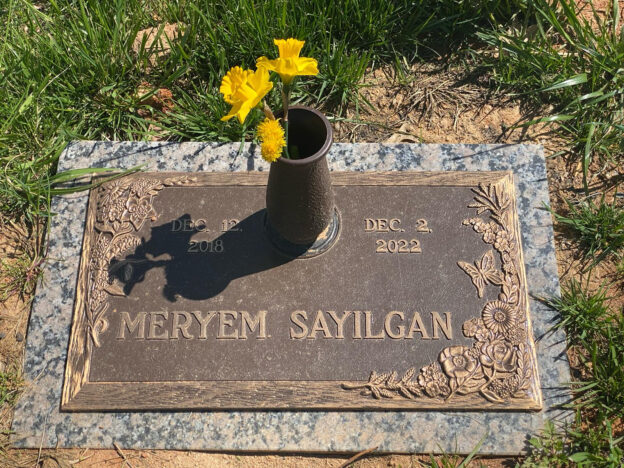
Ongoing wars, pandemics, climate disasters, mass shootings – indeed, death feels more imminent than ever. After my three-year-old daughter Meryem was tragically killed by a truck driver over a year ago, I wanted to confront death. Looking at the pictures of my completely destroyed mini-van, I refused to accept that devastation, chaos, confusion and darkness were the end of my story. I charted out to find meaning, purpose and beauty in the midst of the ugly. In the early stages of my intense grief, I prayed that I not only want to survive this tragedy but grow and thrive with it. I began to process my pain out loud on my podcast, launched a series on facing human mortality in our local community, organized a Faculty Seminar on interreligious perspectives on Death and Dying, and taught an open class on the same subject. As an act of embodied pedagogy, I bring my full self into my professional life and aspire to pull others with me.
In a world which seems to be in perpetual denial of death and offers few spaces to engage this inevitable reality all these efforts have been transformative. [God is the One] Who created death and life in order to test which of you is best in deeds. And He is the Almighty, All-Forgiving,” declares the Qur’an provocatively. Hence, mortality is divinely designed, a piece of art. If death is a purposeful creation by God – by default it cannot be random, meaningless or without wisdom. Quite the opposite – it has life-giving lessons to convey. So, I continue to immerse myself fully into the Muslim practice of memento mori – a meditative experience of cultivating healthy death awareness.
Almost every week the Muslim funeral home sends out at least one or two messages letting the group know that help is needed. Suddenly, death does not seem like a far reality anymore but is close, all-present and shows up with regularity. It reminds me of my life in Türkiye in which the death of someone in the neighborhood is publicly announced over the mosque’s minaret. Everyone can attend the open funeral service, show their last respects and mourn together. Death is a public affair. Strolling through Istanbul, I pass by the many cemeteries in the center of the city, visit and greet the people of the grave as encouraged by Prophet Muhammad. Death and grief are part of life and fully integrated into the city structure and daily rhythm of traditional Muslim societies. The local municipality covers all the costs and provides the burial space. Death is not commercialized.
As I am witnessing, death visits frequently: women and men, young and old, black and white, rich and poor, educated and uneducated. Death does not discriminate. It is an equalizer treating everyone the same as the Qur’an declares, “Every soul will taste death, (Qur’an 3:185). Nonetheless, every person dies in uniquely different ways. Not one death experience is similar to another one. Some deaths feel more painful than others. Visiting my daughter’s graveyard, I also pray for the woman next to her who carries the same first name. A French teacher who was abducted during her evening stroll and brutally murdered. Her body completely dismembered could not be fully recovered. Is it strange that I feel gratitude knowing that my child was not killed by malicious intent and that her body was completely intact? Cemeteries have also become battle grounds for Islamophobes. My infant son who died due to birth complications rests here too. I wonder if it would make a difference to them knowing that half of the cemetery is dedicated to honor the bodies of dead children.
Before I leave for the funeral home, I take my ritual ablution. A symbol of physical and spiritual purification, it prepares the person to be in the right state of mind when meeting the dead. I am a bit nervous before my first visit. What will the dead body look like? How will I react?
For the ritual washing and shrouding of the dead body six volunteers – one lead, five helpers – are needed. The funeral service typically takes place the next day. To delay burials unnecessarily is reprehensible in Islam. The souls long to be reunited with the Creator. Decisions need to be made fast. I am amazed that within five minutes of the group announcement many women immediately step up to come. No hesitation, no reservation, no excuses. We will be there for her, we will honor her, we will show up – for a complete stranger, our sister in Islam. There is so much beauty in this alone. I am in awe of these women who selflessly respond to the call. To answer to the final needs of your fellow sister or brother in faith is a sacred responsibility. I feel humbled and grateful that I can be that person as well. I am also thankful that Islam has not outsourced this obligation but empowers its followers to embrace these Prophetic practices by granting high spiritual rewards. Those who perform them do not ask for any monetary compensation. They simply hope to attain God’s pleasure and love. I appreciate that my tradition espouses solar as well as “lunar spirituality” – the light and the dark. Both are needed for human growth and maturity. Nearness to God is attained by being in these painful spaces as this holy narration explains.
Due to my injuries I was forced to stay in the hospital. When I asked to see my daughter’s dead body in order to kiss and hug her for a final goodbye, it helped me to accept that she was truly gone and eased my grieving process. I could not perform the last rites on her and be present at her funeral. Since then I felt I had missed out on the most important event in our shared life. Perhaps I feel closer to her when being in the presence of the community that she has now joined: The people of the grave. Grief feels less lonely when I am in the company of people who understand the language of loss, who mourn, shed tears and express sadness. It feels comforting to be in a place that allows for difficult emotions to enter and embraces the human being as a whole: joy and sadness, pain and pleasure, the dark and the light, the lows and highs – like the seasons in creation, all changes are necessary for life to thrive. All feelings have their place and I am learning to welcome them all. My involvement in these final rituals is also an act of gratitude towards my community who has supported me and my family in the early weeks of our acute pain. Social connection is essential to sustain ourselves – especially in times of anguish. When we huddle together, the pain is less intense.
After arrival, we walked into the lower floor of the funeral home. When I enter the washing room, I see the dead body wrapped in a big black plastic bag lying on the table. In my heart I feel terror thinking that my child – the most precious person in my life – was treated like that as well. She was put in a freezing, dark morgue – alone with no one on her side. In her last moments she was here – in this cold and unwelcoming basement. I am screaming inside. No warm bunny blankie around her that kept her innocent and pure body cozy. Tears are pouring out now. Death is absolute horror. Cruel and disgraceful.
“Would you like to tell me a little bit about your sister?” I asked the three sisters softly who were joining us now. An invitation, not an imposition. I have discovered that people who grieve are grateful when they can share about the lives who enriched their own. She was a fifty-seven year old woman who came home after a surgery and then suddenly died of complications. How young, I thought. Death does not respect anyone. It does not care about your age, aspirations, dreams, hopes, plans. It did not care that I had invested my best emotional and physical self into my daughter. My sacrifices, my sleepless nights, my physical exhaustion, my dreams and hopes for her – all in vain? Death cannot be negotiated, nor escaped. As Muslims affirm, death is decreed by God alone – regardless of the apparent circumstances, “When their specified time arrives, they cannot delay it for a single hour nor can they bring it forward,” (Qur’an 16:61). I feel comfort as well as distress acknowledging this fact. To know, a higher power with the greatest wisdom and best sense of judgment is in ultimate charge of my end gives me peace. Yet, the Qur’an challenges me to let go of absolute control and surrender to the uncertain.
I learned that she was the middle one among her siblings. She had an adult son and daughter. The sisters do not speak much, they do not shed tears. The atmosphere is quiet and somber. I wonder about their relationships. Did they depart on good terms? I pray I can live a life free from regrets and that I can reconcile early enough with those I have hurt. I take mental notes of those life-giving lessons as I am listening attentively to the wisdom of the deceased sister. I promise myself to say “I am sorry,” “Forgive me,” “I love you,” and “Thank you” more often.
The body is considered a sacred trust in Islam. It needs to be treated with utmost dignity at all times and kept intact. Cremation is therefore strictly prohibited. According to Muslim belief, the spirit is alive, present and observing us closely as we go through the process. We make sure the water has the right warm temperature. We want to comfort her as much as we can. Modesty applies even to the dead body. The Islamic faith instructs us to maintain her dignity and honor as we go through the motions and we must keep her covered, lower our gaze and wash her very gently as outlined in detail by Islamic law. No one looks at her unnecessarily and it is absolutely forbidden to share details about her body with others. Finally, we shroud her into five pieces of white sheet and put her white headscarf on. Every time after we have finished the whole ritual, I am amazed by the expression of tranquility and peace on their faces. They look so beautiful. As if they say to me, “Thank you for beautifying and preparing me for my meeting with my Lord.” I tell them to give my greetings to the heavenly beings and pray for a good ending of my life.
All these essential guidelines are anchored in Islamic law. If the Islamic tradition is so concerned with the needs of the dead, how much more does it call us to preserve the fundamental dignity of every living being? Can a religion that gives so much importance to the deceased, be a threat to society? Here in this room, we treat everyone with the same respect. We transcend gender, racial, ethnic, national, social and political boundaries. Death and grief are universal and a shared human experience: “Indeed, we belong to God, and indeed to Him is our return,” no exceptions as stressed by the Qur’an. None of us is bound to stay. All of us are migratory beings. Migration is part of our spiritual DNA as much as we want to deny it. No one can make an absolute claim on resources, on territories, on wealth, and loved ones. “Be in this world like a stranger or a traveler,” says a holy narration by the Prophet. I take this to mean to cultivate healthy attachments with everyone and anything. Do not obsess or be excessively concerned over worldly affairs because you are destined to leave.
“Remember death often – the destroyer of pleasures,” teaches a Prophetic maxim. And destroying it does. Imagining myself on this table and being stripped off of my agency I cry out: Where is my autonomy, my dignity, my sense of self, my personhood, my freedom? I cannot be treated like that. I have a Ph.D., two Master degrees, I speak several languages, I have worth, I have value, I am more than a stiff, frozen body. This is so degrading. This cannot be my end. Yet, death yells into my face that none of that matters. You came into this world naked owning nothing. Upon arrival you were swaddled into a white blanket and now you are leaving this world swaddled into a blanket again with nothing on you. What is it then that matters on the other side? What is essential on this final journey if I cannot take my family with me, my wealth, my health, my beauty, my reputation? “Everything will perish except His Face. All authority belongs to Him. And to Him you will be returned.” proclaims the Qur’an again. Hope emerges. Everything that is done in His name will last. So long as my living, thinking, feeling and doing is for God – nothing is truly ever lost, wasted or forgotten. What is for eternity, will become eternal.
Death is not glorified in Islam nor avoided. The approach is one of realism. Fear of death is intrinsic to human nature. Too little of it leads to heedlessness, too much of it is debilitating. “Though the physicality of death destroys us, the idea of death may save us,” claims the psychiatrist Irvin D. Yalom. Indeed, mortality gives life meaning. In accepting the agonizing truth of death, I become more mindful, more present and more conscious of my limited time on this earth. I understand that I can depart any minute so I better make sure to use all my resources and all my God-given talents and skills wisely and purposefully. Or in the words of Imam Ali, “Lead such a life, that, when you die, the people may mourn you, and while you are alive they long for your company.”
Back at the graveyard of my daughter, I understand now what supreme goodness looks like. It is to live a life with all your loved ones. No separation, no pain, no heartache. Immortality is the ultimate yearning. It is not a denial of death but a simple, existential human knowing that this is not the end of the human story. The fundamental certainty that supreme goodness exists. I look around me. Spring has arrived and as it is promised in the Qur’an, “Look, then, at the imprints of God’s mercy, how He restores the earth to life after death: this same God is the one who will return people to life after death- He has power over all things.”
I feel spiritually resurrected and revived by these painful insights. So, I return to the world with life-giving lessons gratefully received from the dead.
This essay was published on Religion News Service and in New Orleans Times
The German version appeared on MIGAZIN and in Islamische Zeitung
The Turkish version was published on Perspektif
Discover more from Zeyneb Sayılgan
Subscribe to get the latest posts sent to your email.

 Zeyneb Sayılgan