
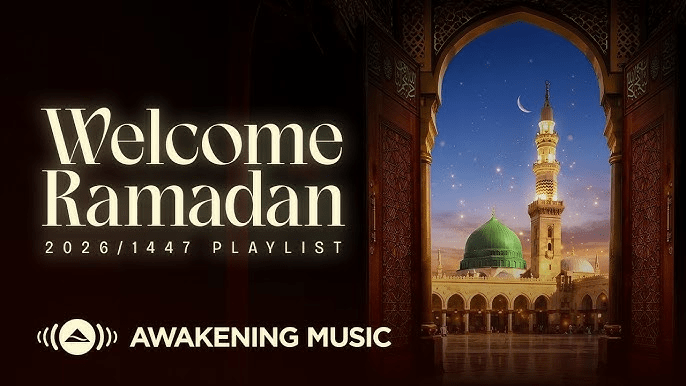
Every year, Ramadan arrives in my home before the crescent moon is officially announced. It arrives in sound. A few days before the month begins, my daughter presses play. The first notes drift through the house, and suddenly the atmosphere shifts. The air feels softer. Our conversations grow gentler. Even the ordinary clatter of dishes seems to fall into rhythm with something sacred.
For as long as I can remember, music has been how we prepare our hearts to welcome Ramadan — like a beloved guest who visits us for thirty days each year. We decorate our house, plan our meals, organize our schedules. But more importantly, we tune our souls.
The first song on my playlist is “Ramadan Moon” by Yusuf Islam aka Cat Stevens. His voice carries longing and tranquility at the same time. When he sings about the Ramadan moon lighting up the world, I feel the tenderness of anticipation. It reminds me that Ramadan is not merely a date on the calendar; it is a mercy descending gently upon us.
In recent years, listening to “Ramadan Moon” has become part of another family ritual: moonsighting. We gather with other families and drive to the local observatory, children bundled in jackets, thermoses of tea in hand. As we wait for the slender crescent to appear, someone plays the song softly from a phone speaker. The melody mingles with the cool evening air and the excited whispers of children scanning the horizon. When the moon is finally sighted, cheers erupt. In that moment, faith, science, community, and song feel beautifully intertwined.
Ramadan is, above all, the month of the Qur’an — the month in which revelation began. Each year, I set a personal intention to reconnect with the Qur’an more deeply: to read it reflectively, to listen to its recitation slowly, to let it question me. And the Qur’an itself explains the purpose of fasting in words that feel both direct and transformative:
“O you who believe, fasting has been prescribed for you as it was prescribed for those before you, so that you may attain God-consciousness (taqwa),” (Qur’an 2:183)
That word — taqwa — is the heart of Ramadan. It means living with an awareness of God that shapes our character, our speech, our choices. Fasting trains the soul to pause before reacting, to speak with care, to act with integrity. It cultivates restraint and compassion. It is about becoming more conscious of God — and therefore more conscious of how we treat one another.
The second song, “Ramadan Is Here” by Raef, lifts my spirit with joyful expectancy. The song feels like doors opening and families embracing. It captures the communal excitement of the first night of the special Taraweeh prayers — when mosques fill shoulder to shoulder and community members embrace one another.
Ramadan is deeply personal, but it is never solitary. We wake for the pre-dawn meal (suhoor) together, we break our fast together at iftar, and we stand together in prayer. Raef’s melody mirrors those moments — the laughter at the table, the shared dates passed around, the whispered supplication before the first sip of water. His lyrics celebrate Ramadan as a gift, a reset button for the soul. And that is exactly how I experience it: a chance to begin again.
The third song, “Ramadan” by Maher Zain, carries a deeper emotional register. Whenever I hear it, I think about spiritual self-development. Ramadan asks more of us than abstaining from food and drink. It calls us to be attentive to our speech, our tempers, our habits. It invites us to examine our intentions and refine our character.
I often recall the words of Prophet Muhammad stating: “Whoever does not give up forged speech and evil actions, God is not in need of his leaving his food and drink,” (Hadith).
The message is unmistakable: Ramadan is not about hunger for its own sake. It is about moral and spiritual transformation. If my fasting does not soften my speech or purify my intentions, then I have misunderstood its purpose.
Here, I also remember the reflection of Bediüzzaman Said Nursi in his Risale-i Nur Collection:
“Fasting in Ramadan, then, is the key to true, sincere, extensive, and universal thankfulness. For at other times of the year, most people whose circumstances are not difficult do not realize the value of many bounties since they do not experience real hunger. If their stomachs are full and especially if they are rich, they do not understand the degree of bounty present in a piece of dry bread. But when it is time to break the fast, the sense of taste testifies that the dry bread is a precious divine bounty in the eyes of a believer. During Ramadan, everyone from the monarch to the destitute manifests a sort of gratitude through understanding the value of those bounties,” (The Letters)
Through fasting, blessings that once felt ordinary become extraordinary. A single date tastes sweeter. A glass of water feels like a miracle. Gratitude becomes embodied. Hunger humbles me and awakens empathy for those who experience scarcity not as a spiritual exercise but as daily reality.
The fourth song, “Ramadan” by Deen Squad, pulses with contemporary rhythm. It feels youthful and confident, reminding me that Ramadan is alive in every generation. It belongs to our children as much as to our grandparents.
Deen Squad’s energy captures another essential dimension of the month: community building and charitable work. Ramadan is when neighborhoods organize food drives, when mosques host open iftars, when we calculate our charity tax (zakat) and search for ways to give quietly and generously. The fast awakens solidarity. It pushes me beyond my comfort zone into acts of service.
Ramadan is a guest, yes. But it is also a teacher. It teaches restraint in a world of excess. It teaches reflection in a culture of distraction. It teaches solidarity in a time of fragmentation. And as the Qur’an reminds us, it ultimately teaches taqwa — a cultivated awareness of God that shapes good character. Like any honored guest, Ramadan leaves too quickly. On the night before Eid, when the music fades and the month slips away, I always feel a bittersweet ache. Yet I also feel hope.
Because every year, when the first song plays again, I know the door is opening once more. The Ramadan moon will rise. The Qur’an will be recited. Hands will be raised in prayer. Tables will be shared. Hearts will soften. And in the gentle weaving of melody, memory, discipline, and mercy, I will welcome this beloved guest again — grateful for another chance to grow in God-consciousness and grace.
And when the month finally gives way to the Eid holiday, another song accompanies us: “Eid Song” by Sami Yusuf. For me, this song marks the emotional transition from inward reflection to joyful gratitude. It carries a festive lightness without losing the spiritual depth of Ramadan. After days of discipline, self-examination, and restraint, it reminds us that joy itself is an act of thankfulness. The Festival of Eid is not merely a conclusion, but a spiritual harvest — a celebration of our sincere effort to grow. Sami Yusuf’s song gives this joy a voice: it weaves together community, gratitude, and hope, allowing us to feel that spiritual striving ultimately blossoms into light and celebration.
These songs accompany me not only in my private life, but also in my pedagogy. In my seminars, I intentionally use them to offer non-Muslims an entry point into the spirit of Ramadan. Rather than explaining the month solely through rules or theological terminology, I begin with music. Together, we listen to selected passages, discuss the emotions they evoke, and reflect on themes such as longing, gratitude, self-discipline, and community. Music creates an emotional space of resonance in which students — regardless of their (non-) religious background — can recognize parallels to their own experiences: waiting for a meaningful celebration, sharing meals with family, striving for self-improvement, longing for deeper purpose.
In this way, Ramadan is not presented in the classroom as “the Other,” but as a profoundly human experience. Students come to understand that fasting is not merely abstention, but heightened awareness; that prayer is not only ritual, but relationship; that community signifies not just belonging, but responsibility. By the end, many express that they have begun to appreciate the beauty of this month — even if they do not observe it themselves.
In a world where headlines often reduce Muslims to statistics or stereotypes, music, art, and poetry tell a different story. Learning about the spiritual songs that accompany Ramadan humanizes the nearly two billion Muslims around the world. It affirms their dignity, creativity, and shared longing for meaning. A simple “Happy Ramadan” or “Ramadan Mubarak” offered with sincerity can light up someone’s face. It says: I see you. I honor what is sacred to you.
Zeyneb Sayılgan, Ph.D., is the Muslim Scholar at the Institute for Islamic, Christian and Jewish Studies in Baltimore. Her research centers mainly around Islamic theology, ethics and spirituality as articulated in the writings of Muslim scholar Bediüzzaman Said Nursi (1876-1960). Her other areas of interest are Christian-Muslim relations and the intersection of religion and migration. Zeyneb’s personal experience of growing up in Germany as the daughter of Muslim immigrants from Türkiye informs her academic work and engagement in Christian-Muslim relations. Her articles have been published in The Guardian, Religion News Service, U.S. Catholic, The Living Church, and German and Turkish outlets. To read her work and listen to her podcast visit her blog.
An adapted version was published in The Washington Post
The Turkish translation was published on Perspektif
Discover more from Zeyneb Sayılgan
Subscribe to get the latest posts sent to your email.

 Zeyneb Sayılgan